Last Updated: May 2026 | Reading Time: 12 min
The ChatGPT vs Google rivalry is the most important shift in digital marketing in over two decades. For years, Google was the only game in town. But in 2026, a new challenger has completely changed how people search for information — and it’s not another search engine. It’s an AI chatbot.
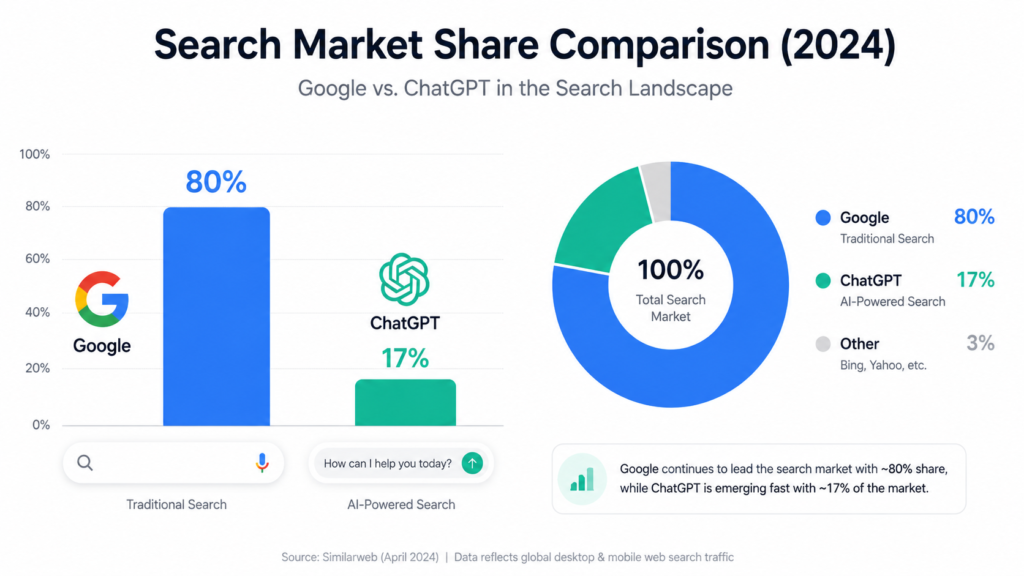
ChatGPT has captured 17% of the global search market, making it the first double-digit competitor to Google’s dominance in over 20 years. This ChatGPT vs Google battle is no longer just a tech story — it’s a business survival issue.
According to data from Statista’s Digital Market Outlook, AI-powered search tools are projected to continue growing their market share through 2027.
If your business is only optimized for Google, you are now invisible to a rapidly growing audience that prefers AI-powered answers over traditional blue links.
In this complete guide, we break down the ChatGPT vs Google search battle, show you exactly where each platform wins, and give you a proven dual-optimization strategy to dominate both platforms in 2026.
📌 Related Service: Need help with search visibility? Check out our SEO Services →
ChatGPT vs Google: The 2026 Search Landscape & Key Numbers
To understand who wins the ChatGPT vs Google battle, let’s start with the data. The search market in 2026 is no longer a one-player game. 4 Google holds about 81.6% of the global search market with roughly 4.9 billion monthly active users. ChatGPT accounts for around 9% of the market with about 542 million monthly users. The remaining 7.4% is shared by other players such as Bing, Perplexity, and niche search engines.
But here’s the critical insight most businesses miss — these numbers don’t tell the full story, because how people use each platform is radically different.
Session Duration: Google vs ChatGPT
When measuring engagement in the ChatGPT vs Google battle, session duration is a key metric. A typical Google session lasts just over 5 minutes, compared with more than 14 minutes on ChatGPT.This means ChatGPT users are significantly more engaged, spending nearly 3x more time interacting with the platform.
The User Behavior Shift
4 Users still turn to Google for fast lookups and everyday tasks, but increasingly rely on ChatGPT for longer, creative, and in-depth conversations—especially younger users, professionals, and creators. 2 Users frequently switch between both platforms during a single research session. This hybrid behavior means your business **must** be visible on both.
📌 Related Reading: Learn how our Content Marketing Services can position your brand on both platforms →
ChatGPT vs Google: Who Wins for Which Search Intent?
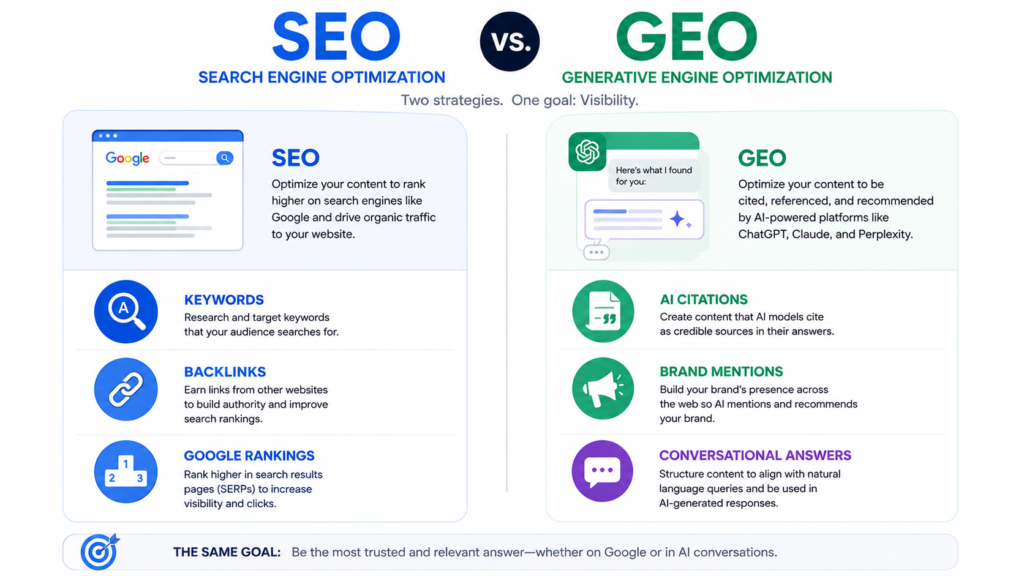
Not every search is created equal. In the ChatGPT vs Google comparison, the intent behind the query determines which platform users prefer.
🔵 Where Google Dominates
6 Google retains dominance in transactional and navigational queries — users seeking local services, specific purchases, or business information where its Maps integration and extensive local database provide clear advantages.
- “Best restaurants near me” → Google Maps
- “Buy iPhone 16 Pro Max” → Google Shopping
- “Nike.com” → Direct navigation
- “Plumber in Dubai” → Local SEO results
4 For regular information questions, Google is still number one with 71%.
🟢 Where ChatGPT Dominates
6 ChatGPT has captured informational and creative searches, where conversational AI excels at synthesizing complex answers. 4 ChatGPT has 64% of the market share in creative tasks like coming up with ideas, writing, and brainstorming. In comparison, Google has 29%.
- “Write a marketing strategy for my bakery” → ChatGPT
- “Compare SEO vs PPC for small businesses” → ChatGPT
- “Explain blockchain in simple terms” → ChatGPT
- “What’s the best CRM for a startup?” → ChatGPT
📊 Quick Comparison Table
| Feature | ChatGPT | |
|---|---|---|
| Market Share | ~80% | ~17% |
| Session Duration | ~5 min | ~14 min |
| Best For | Transactional, Local, Navigation | Informational, Creative, Research |
| Output Format | Links + Snippets | Synthesized Answers |
| Monetization | Ads (Google Ads) | Emerging (ChatGPT Ads) |
| Age Group Preference | All ages (85%+ for 45+) | Younger users (Gen Z & Millennials) |
📌 Related Service: Reach local customers with our Google My Business Optimization →
The Rise of Generative Engine Optimization (GEO)
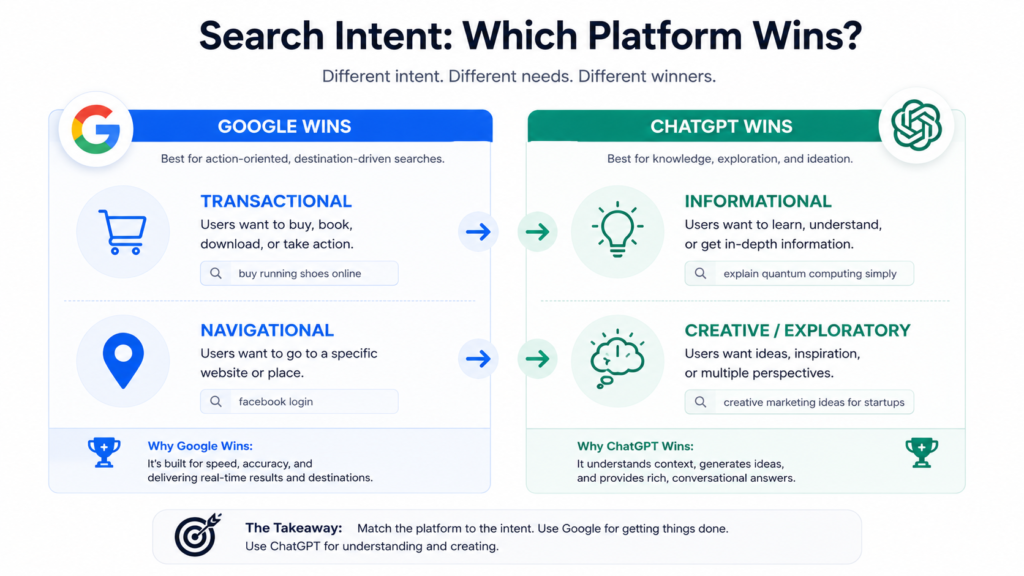
Here’s the most important concept you need to understand in 2026: GEO.22 Generative engine optimization (GEO) is the practice of optimizing your content so that AI search engines cite it in their responses. If traditional SEO is about ranking on page one of Google, GEO is about being part of the answer itself.
SEO vs GEO: What’s the Difference?
23 SEO (Search Engine Optimization) focuses on ranking links in a retrieval system (like Google) based on keywords and backlinks. GEO (Generative Engine Optimization) focuses on getting cited in a synthesized answer by an LLM (like ChatGPT) based on fact density, authority, and semantic structure. 6 This has spawned Generative Engine Optimization (GEO), a new practice where publishers compete to be cited within AI responses rather than ranking in traditional search results. Princeton University researchers who coined the term found that adding citations, quotations, and statistics boosts source visibility by over 40% across various queries.
Why You Can’t Ignore GEO
9 Gartner predicts that traffic to the web from search engines will fall by 25% by 2026, primarily due to AI experiences handling queries without sending users to websites.
But here’s the silver lining: 9visitors coming from AI search experiences already convert 4.4 times better on average than visitors from classic organic search.
That means less traffic but better quality leads from AI platforms.
Princeton University researchers who coined the term GEO found that adding citations, quotations, and statistics boosts source visibility by over 40% across various query types.
📌 Related Service: Let our Digital Marketing Strategy team build your dual SEO + GEO plan →
How to Be Visible on Google in 2026 (SEO Essentials)
Google isn’t going anywhere. Here’s your updated SEO checklist:
1. Master E-E-A-T (Experience, Expertise, Authoritativeness, Trustworthiness)
Google continues to prioritize content that demonstrates real experience and expertise. Make sure every piece of content on your site showcases:
- Author bios with credentials
- First-hand experience and original insights
- Client case studies and real results
- Trust signals like reviews, testimonials, and certifications
2. Optimize for AI Overviews
5 AI Overviews (and related AI features) mean marketers must adapt even within Google. Google’s own AI summaries now appear at the top of many search results. To be featured:
- Answer questions directly in the first 2-3 sentences
- Use structured data (Schema markup)
- Create FAQ sections on your pages
- Use clear H2 and H3 heading structures
3. Double Down on Local SEO
Google dominates local searches. Make sure you have:
- A fully optimized Google Business Profile
- Consistent NAP (Name, Address, Phone) across all directories
- Local content targeting your service area
- Customer reviews on Google
4. Technical SEO Fundamentals
- Core Web Vitals (Page Speed, Interactivity, Visual Stability)
- Mobile-first indexing
- Clean URL structures
- Proper internal linking
- XML sitemap submission
5. Build Topic Clusters
Instead of targeting isolated keywords, create comprehensive topic clusters with a pillar page and supporting articles that build topical authority.
📌 Related Service: Get a complete SEO Audit for your website →
How to Be Visible on ChatGPT in 2026 (GEO Strategy)
Now for the game-changer. Here’s exactly how to optimize for ChatGPT visibility:
1. Don’t Block AI Crawlers
25 During the initial release of ChatGPT, numerous websites opted to block OpenAI’s web crawler to prevent their content from being accessed to train AI tools. If your website was among them, your robots.txt file likely includes the directive “Disallow: /” under the “User-agent: OAI-SearchBot” section.
Action: Check your robots.txt file right now and make sure you’re NOT blocking OAI-SearchBot and GPTBot.
You can verify which AI bots are allowed by reviewing OpenAI’s official crawler documentation and updating your robots.txt accordingly
2. Optimize for Bing (Critical!)
23 For real-time answers, ChatGPT (via its Search feature) often uses Bing’s index to retrieve live information. Being indexable by Bing is therefore critical for ChatGPT visibility.
Action Steps:
- Register your site in Bing Webmaster Tools
- Submit your sitemap to Bing
- Ensure your metadata is clean and accurate
3. Create Citation-Worthy Content
22 AI systems evaluate source credibility when deciding which pages to cite. Give them clear signals that your content is trustworthy. Add expert quotes with attribution — include quotes from named experts with their title and company. AI systems treat this as a strong authority signal. Cite statistics with sources. When you include data, name the source.
Your content should include:
- Original statistics and data
- Expert quotes with full attribution
- Specific numbers instead of vague claims
- Clear, direct answers to common questions
4. Structure Content for AI Consumption
29 Use clear H2s, bullet points, and short paragraphs. Structured layouts make it easier for AI models to extract information accurately and feature your content as direct snippets.
- Use clear question-answer formats
- Include summary boxes and key takeaways
- Write in a conversational tone
- Answer the “what, why, how” completely
5. Build Brand Authority Across the Web
25 ChatGPT considers credibility, relevance, accuracy, recency, and engagement when choosing a website to reference. Additional factors include brand mentions, reviews, relevance, website age, recommendations, and authority.
Action Steps:
- Get featured on industry publications
- Earn mentions on authoritative websites
- Collect and display customer reviews
- Maintain active social media profiles
- Publish original research
6. Use Schema Markup
29 Use structured formats such as Schema and JSON-LD so ChatGPT can easily interpret your content and surface it in responses.
Implement:
- Organization schema
- Article schema
- FAQ schema
- How-To schema
- Review schema
📌 Related Service: Our Web Development Team can implement schema markup on your site →
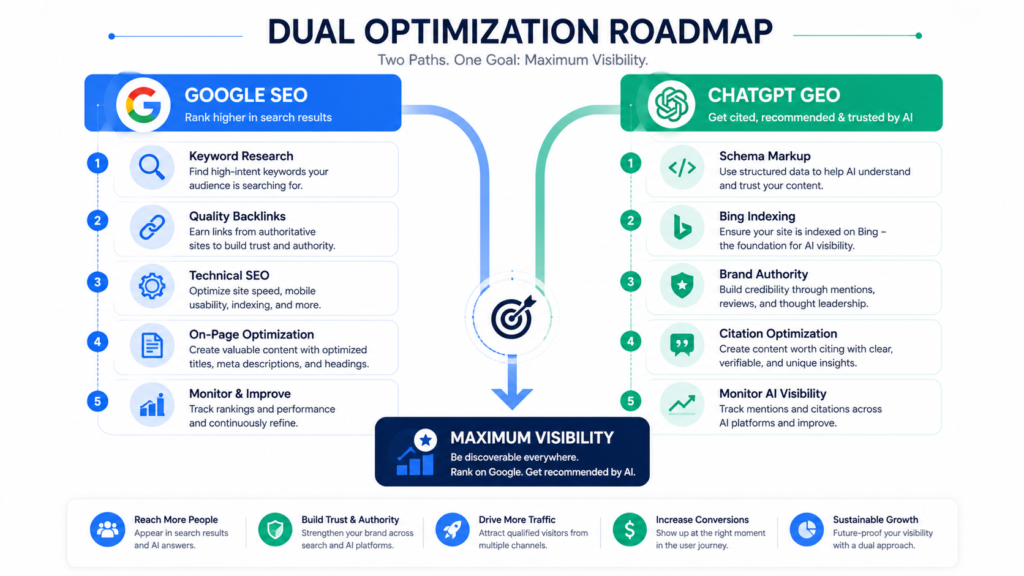
The Dual-Optimization Strategy: Your 2026 Action Plan
5 The winning strategy in 2026 is a hybrid: keep traditional SEO for scale, while investing in GEO (Generative Engine Optimization) to increase the likelihood your brand is referenced by models powering ChatGPT-style experiences and answer engines.
Here’s your complete action plan:
Phase 1: Foundation (Week 1-2)
- ✅ Audit your current Google rankings and organic traffic
- ✅ Test 20+ prompts on ChatGPT related to your business and document if/where your brand appears
- ✅ Check your
robots.txt— unblock AI crawlers - ✅ Register and verify on Bing Webmaster Tools
- ✅ Implement schema markup across your site
Phase 2: Content Strategy (Week 3-6)
- ✅ Build topic clusters around your core services
- ✅ Create pillar content with citation-worthy statistics and expert quotes
- ✅ Write FAQ pages that directly answer common industry questions
- ✅ Update existing content with better structure (H2s, bullets, summary boxes)
- ✅ Start publishing comparison articles and “Best of” lists
Phase 3: Authority Building (Ongoing)
- ✅ Pursue digital PR and guest publications
- ✅ Collect and respond to customer reviews
- ✅ Build brand mentions across social media, forums, and directories
- ✅ Create original research and data-backed content
- ✅ Monitor AI citations and adjust strategy accordingly
Phase 4: Measure & Optimize (Monthly)
- ✅ Track Google rankings via Search Console
- ✅ Monitor ChatGPT brand mentions weekly
- ✅ Measure referral traffic from AI platforms in Google Analytics
- ✅ Track new KPI: Citation Rate alongside Click-Through Rate
23 E-commerce teams must broaden their KPIs from just “Click-Through Rate” (CTR) to include “Citation Rate” — the frequency with which your brand is used as a trusted source to construct an AI answer.
📌 Related Service: Get our Monthly Digital Marketing Management to execute this plan →
ChatGPT vs Google: Future Trends Every Marketer Must Know
The ChatGPT vs Google landscape is evolving rapidly. Here’s what’s coming next and how it will affect your strategy:
1. ChatGPT Advertising is Here
9 As AI platforms capture more traffic, they are also monetizing it. OpenAI has launched advertising inside ChatGPT, creating a new performance marketing channel.
2. Gemini Is Rising Fast
7 OpenAI’s ChatGPT app market share fell from 69.1% in January 2025 to 45.3% in 2026. Over the same period, Google’s Gemini chatbot app increased its market share from 14.7% to 25.2%.
3. Multi-Platform AI Usage Is Growing
7 One in five AI users now uses multiple apps, suggesting users might be finding different tools useful for various tasks—opening up the possibility of a market where AI companies can carve out a niche.
4. Search is Fragmenting, Not Dying
9 The strategic takeaway is not “SEO is dead,” but rather: Search is fragmenting. 9 Google will remain huge, but AI engines and agents will control an ever-larger slice of discovery and decision-making.
Final Thoughts: Win the ChatGPT vs Google Battle for Your Brand
The ChatGPT vs Google battle isn’t about choosing sides. It’s about recognizing that your potential customers are now on both platforms, and your business needs to be visible wherever they search.5 The brands that win in 2026 will treat AI visibility as a strategic asset: they’ll publish citable content, build authority signals, and measure share of answers—not just share of clicks.
The businesses that adapt to this dual-platform reality will capture more leads, build more trust, and grow faster than those still playing the single-channel SEO game.
🚀 Ready to Dominate Both Google and ChatGPT?
At Risala Digital Marketing, we specialize in helping businesses become visible on both traditional search and AI-powered platforms. Whether you need SEO optimization, content marketing, PPC advertising, or a complete digital marketing strategy, our team is ready to help you grow.
📞 Contact Us Today for a Free Consultation →