
AI SEO is completely transforming how businesses rank on Google — and if you are still relying entirely on manual content creation, you are already falling behind your competitors.
Search engine optimization is changing faster than ever. Traditional SEO strategies that once focused only
on keywords and backlinks are now evolving into something far more intelligent. In 2026, businesses are
no longer relying entirely on manual blogging and repetitive content creation. Instead, they are combining artificial intelligence with smart human strategy to scale content production, improve rankings, and dominate search results.
Search engine optimization is changing faster than ever. Traditional SEO strategies that once focused only on keywords and backlinks are now evolving into something much more intelligent. In 2026, businesses are no longer relying entirely on manual blogging and repetitive content creation. Instead, they are combining artificial intelligence with smart human strategy to scale content production, improve rankings, and dominate search results.
The rise of AI-powered tools has completely transformed the way marketers approach SEO. From keyword research and topic clustering to automated content optimization and workflow automation, AI is now involved in nearly every stage of digital marketing.
However, there is one major misconception businesses still have: AI alone cannot guarantee rankings.
Search engines are becoming smarter. Google now prioritizes useful, experience-driven, and trustworthy content over mass-produced AI articles. This means businesses that combine automation with genuine expertise will have the biggest advantage in the coming years.
In this guide, we will explore how AI SEO works, which strategies are dominating in 2026, and how businesses can use AI correctly without damaging their rankings.
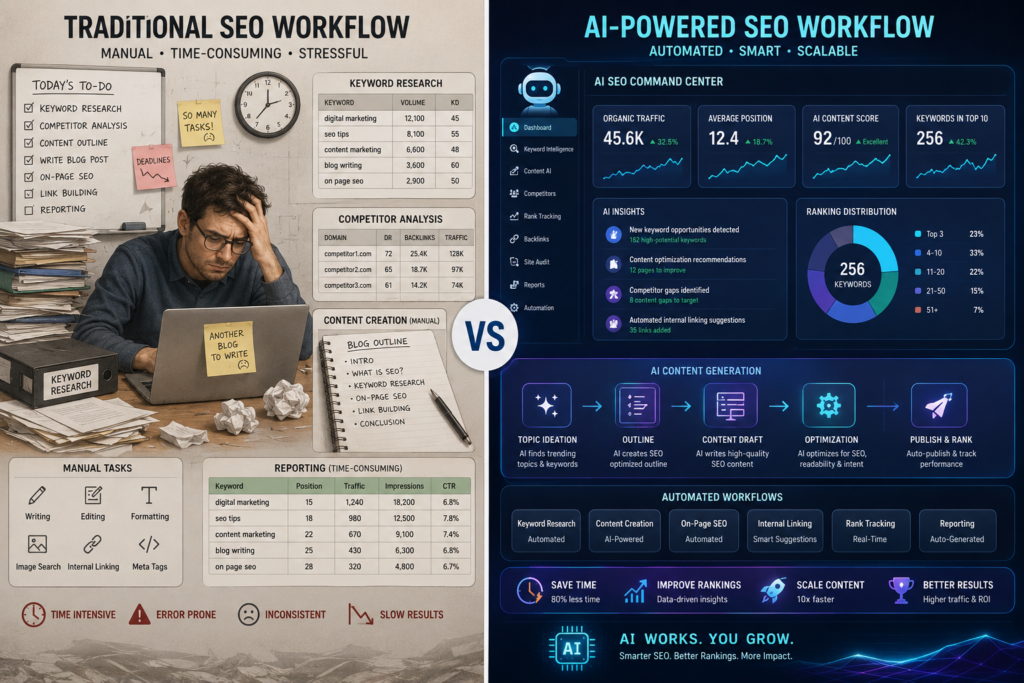
Traditional SEO vs AI SEO
Traditional SEO required businesses to spend hours on manual keyword research, writing, editing, optimization, and publishing. A single blog post could take days to complete. Today, AI tools can automate a large portion of that workflow.
Modern SEO is no longer about simply publishing content. It is about building topical authority, understanding user intent, and creating a scalable content ecosystem.
Businesses that fail to adapt to AI-powered workflows are already falling behind competitors who publish faster, optimize smarter, and analyze search trends more efficiently.
What is AI SEO?
AI SEO refers to the use of artificial intelligence tools and automation systems to improve search engine optimization processes. Instead of manually handling every SEO task, businesses now use AI to accelerate workflows, identify opportunities, and generate data-driven insights.
AI SEO can help with:
- Keyword clustering
- Content ideation
- Search intent analysis
- Internal linking
- SEO audits
- Content optimization
- Meta description generation
- Competitor analysis
- Automation workflows
Tools like OpenAI, Semrush, Ahrefs, and Surfer SEO are helping marketers automate repetitive tasks that previously consumed enormous amounts of time.
For example, businesses can now generate blog outlines in minutes, automatically optimize headings based on competitor data, and create SEO content clusters using AI-powered analysis.
Another major advantage is automation integration. Platforms like Make allow marketers to connect AI writing tools directly with content management systems such as WordPress. This creates a partially automated publishing workflow that significantly increases content production speed.
However, successful AI SEO is not about replacing humans. It is about improving efficiency while maintaining quality and originality.
Why Google Still Rewards Human Strategy
Despite the rapid rise of AI-generated content, search engines still prioritize authenticity and user value. This is why blindly publishing AI-written blogs without editing or expertise often fails to rank.
Google’s ranking systems increasingly focus on EEAT:
- Experience
- Expertise
- Authoritativeness
- Trustworthiness
This means businesses need more than just volume. They need high-quality insights, original thinking, and strong topical relevance.
AI can generate information quickly, but it cannot fully replicate real-world experience, unique case studies, or genuine industry expertise. Search engines are becoming increasingly effective at identifying thin content and repetitive AI-generated material.
Human strategy is still essential for:
- Understanding audience psychology
- Building brand voice
- Creating trust
- Adding unique insights
- Improving storytelling
- Developing content strategy
Businesses that combine AI speed with human creativity are achieving the best results.
For example, a digital marketing agency can use AI to generate an article structure, research keywords, and automate optimization. But the final content should still include real examples, expert analysis, and strategic editing performed by humans.
This hybrid approach creates content that performs well both for users and search engines.
Best AI SEO Strategies for 2026
1. Building Topical Authority
One of the biggest SEO trends in 2026 is topical authority.
Instead of publishing random blog posts, businesses are now creating complete content ecosystems around specific subjects. AI tools help identify related topics, search intent variations, and keyword clusters.
For example, instead of publishing one article about SEO, businesses create interconnected content around:
- Technical SEO
- Local SEO
- AI SEO
- Content optimization
- SEO automation
- Google updates
- Link building
- Search intent
This signals expertise to search engines and improves rankings across multiple keywords.
2. AI-Assisted Keyword Research
Traditional keyword research often focused only on search volume. AI-powered tools now analyze:
- User intent
- Competitor gaps
- Semantic relevance
- Content depth
- Trend forecasting
This allows businesses to identify low-competition opportunities much faster.
AI can also group keywords automatically into clusters, helping marketers build better content structures.
3. Programmatic SEO
Programmatic SEO is becoming increasingly powerful in 2026.
This strategy uses templates, automation, and AI-generated data to create large numbers of highly targeted landing pages.
Examples include:
- City-specific service pages
- Industry-specific guides
- Location-based SEO pages
- Comparison pages
- Tool pages
When done correctly, programmatic SEO can generate massive organic traffic.
However, quality control is critical. Thin pages created purely for search engines rarely perform well long term.
4. Automated Internal Linking
Internal linking is often ignored, even though it is extremely important for SEO.
AI tools can now automatically suggest relevant internal links based on semantic relationships between articles.
This improves:
- Crawlability
- User experience
- Session duration
- Topical authority
- Page indexing
A strong internal linking structure helps search engines better understand your website architecture.
5. Content Repurposing
Modern SEO is no longer limited to blog posts.
Businesses are now repurposing content into:
- YouTube videos
- LinkedIn posts
- Instagram carousels
- Short-form videos
- Newsletters
- Podcasts
AI tools help transform one piece of content into multiple formats, allowing brands to expand visibility across platforms.
This multi-channel strategy increases brand authority and improves overall discoverability.
6. Search Intent Optimization
Search intent is becoming more important than keyword density.
Businesses that understand why users search are outperforming websites that focus only on keywords.
AI tools can analyze search results and identify whether users want:
- Information
- Comparison
- Solutions
- Tutorials
- Products
- Services
This helps marketers create content that directly matches user expectations.
Common Mistakes Businesses Make with AI SEO
While AI offers enormous advantages, many businesses misuse it.
One of the biggest mistakes is publishing raw AI-generated content without editing. This often leads to generic articles that provide little value.
Another major issue is keyword stuffing. Some marketers still believe adding excessive keywords improves rankings. In reality, modern search engines prioritize readability and user experience.
Businesses also frequently ignore:
- Fact-checking
- Content originality
- User engagement
- Content depth
- Brand voice consistency
AI-generated content should always be reviewed by humans before publishing.
Another mistake is relying entirely on automation without strategy. AI can assist with execution, but it cannot replace critical thinking and long-term marketing planning.
Businesses that prioritize quality over quantity are seeing far better long-term SEO results.
The Future of SEO: AI + Brand Authority
The future of SEO is no longer limited to websites alone.
Search visibility is expanding across:
- AI assistants
- Voice search
- Video platforms
- Social media
- Search generative experiences
- Multi-platform ecosystems
Brands that build authority across multiple channels will dominate search visibility in the coming years.
Video SEO is especially growing rapidly. Platforms like YouTube are functioning as search engines themselves. Businesses that combine written content with video content are increasing reach significantly.
Personal branding is also becoming a major ranking factor indirectly. Businesses with strong founders, public trust, active communities, and recognizable expertise are gaining more engagement and backlinks naturally.
In 2026, successful SEO will depend on:
- Fast websites
- Strong UX
- Helpful content
- Authentic expertise
- Consistent publishing
- Multi-platform visibility
- Trust signals
AI will continue transforming digital marketing, but brand authority will remain essential.
Final Thoughts
AI SEO is not about replacing marketers. It is about helping businesses work smarter, publish faster, and optimize more efficiently.
The businesses winning in 2026 are not the ones blindly generating thousands of AI articles. They are the brands strategically combining automation with expertise, creativity, and authentic value.
AI can accelerate workflows, improve productivity, and uncover opportunities that were previously difficult to identify. But long-term SEO success still depends on trust, quality, and user satisfaction.
As search engines evolve, businesses that adapt early to AI-assisted SEO strategies will gain a significant competitive advantage.
The future belongs to brands that understand how to balance automation with human intelligence.