
Table of Contents
In the world of digital marketing,Meta Ads vs Google Ads is one of the debate that continues to dominate conversations among business owners, marketers, and agencies: Meta Ads vs Google Ads. If you’re investing money into paid marketing, choosing the right platform can significantly impact your return on investment, lead quality, and overall business growth.
This Meta Ads vs Google Ads guide will help you understand the strengths, weaknesses, costs, targeting capabilities, and ideal use cases for both advertising platforms. By the end, you’ll know exactly which platform deserves your budget in 2026.
Whether you’re running a local business, an ecommerce store, a service company, or a B2B organization, understanding this Meta Ads vs Google Ads Comparison is critical for maximizing advertising performance.
What Is Meta Ads?
Meta Ads refers to the advertising ecosystem across:
- Messenger
- Audience Network
Meta Ads allow businesses to reach users based on interests, demographics, behaviors, and engagement patterns.
Unlike search advertising, Meta focuses on interruption marketing.
Users aren’t actively searching for your product. Instead, your advertisement appears while they browse social media.
This creates opportunities to generate awareness and demand.
Popular Meta Ad formats include:
- Image Ads
- Video Ads
- Carousel Ads
- Lead Form Ads
- Reels Ads
- Story Ads
Meta remains one of the most powerful customer acquisition platforms available today.
What Is Google Ads?
Google Ads is Google’s advertising platform that enables businesses to appear across:
- Google Search
- YouTube
- Google Display Network
- Gmail
- Google Maps
- Discover Feed
Unlike Meta, Google primarily captures existing demand.
When someone searches:
- Best digital marketing agency
- SEO services near me
- Emergency plumber
- Buy running shoes
they already have intent.
This makes Google Ads particularly effective for lead generation and direct sales.
Popular campaign types include:
- Search Campaigns
- Performance Max
- Display Campaigns
- Video Campaigns
- Shopping Campaigns
- Local Campaigns
Google Ads often delivers higher intent traffic compared to social media advertising.
Paid Ads Comparison: User Intent
One of the biggest differences in this Paid Ads Comparison comes down to user intent.
Google Ads
Google captures demand.
The customer is already searching.
Examples:
- Buy laptop online
- Dentist near me
- Website design services
The user already wants something.
Your job is simply to appear when they’re looking.
Meta Ads
Meta creates demand.
Users aren’t actively searching.
Instead, you’re introducing products and services they may not have considered.
Example:
A restaurant advertisement appears in someone’s Instagram feed.
The person wasn’t searching for restaurants, but now they might visit.
This distinction is critical when choosing your platform.
Audience Targeting Comparison
Targeting is another major factor in this Paid Ads Comparison.
Meta Ads Targeting
Meta excels at audience segmentation.
You can target users based on:
- Age
- Gender
- Location
- Interests
- Behaviors
- Engagement history
- Lookalike audiences
Meta’s algorithm is incredibly powerful at identifying similar users who are likely to convert.
Google Ads Targeting
Google primarily targets intent.
Targeting options include:
- Keywords
- Search terms
- Geographic location
- Device type
- Audience segments
- In-market audiences
Google’s greatest strength is matching advertisements with search intent.
Cost Comparison
Cost is often the first question businesses ask.
Meta Ads Cost
Meta generally offers:
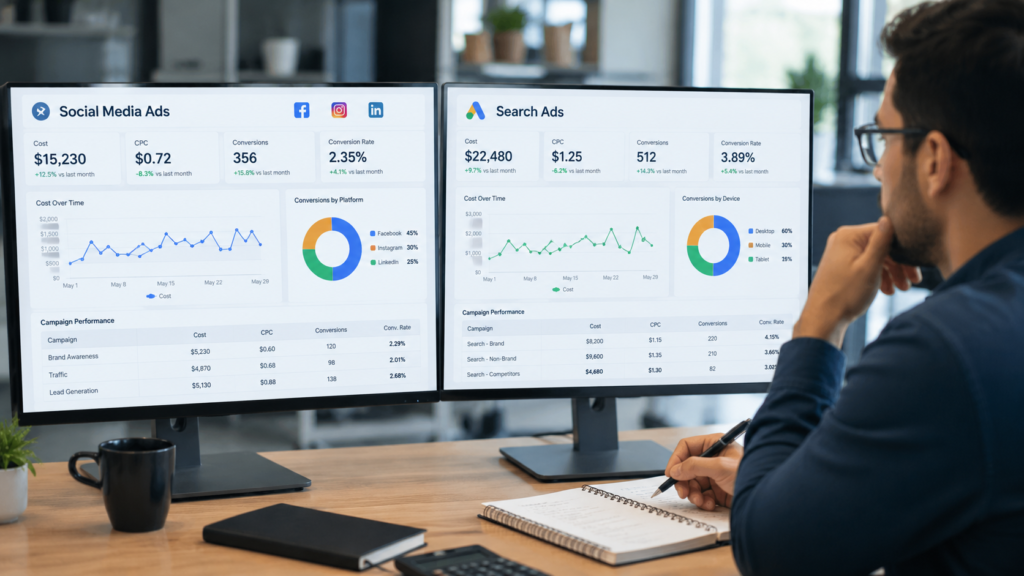
- Lower CPC (Cost Per Click)
- Lower CPM (Cost Per Thousand Impressions)
- More affordable awareness campaigns
Businesses can often reach thousands of users at relatively low costs.
Google Ads Cost
Google typically costs more.
Competitive industries such as:
- Legal services
- Insurance
- Marketing
- Finance
can see extremely high CPCs.
However, higher costs often come with stronger buying intent.
Paying more per click can still be profitable if conversion rates remain high.
Lead Quality Comparison
Lead quality often matters more than lead quantity.
Google Ads Lead Quality
Because users actively search for solutions, Google Ads often generates:
- Higher purchase intent
- Faster conversions
- Better-qualified leads
This makes Google ideal for:
- Service businesses
- Local businesses
- Emergency services
- B2B companies
Meta Ads Lead Quality
Meta may generate larger volumes of leads.
However, qualification can vary significantly.
Businesses often need:
- Follow-up systems
- Email nurturing
- Retargeting campaigns
to convert Meta leads into customers.
Best Platform for Ecommerce
For ecommerce businesses, both platforms can perform exceptionally well.
Meta Ads Strengths
Ideal for:
- Product discovery
- Impulse purchases
- Brand awareness
- Retargeting
Visual products perform particularly well.
Examples:
- Fashion
- Beauty
- Home decor
- Fitness products
Google Ads Strengths
Ideal for:
- High-intent searches
- Shopping campaigns
- Product comparisons
- Bottom-funnel conversions
Many successful ecommerce brands use both platforms together.
Best Platform for Service Businesses
Service-based businesses often ask which platform delivers better leads.
The answer depends on the service.
Google Ads Works Best For
- Plumbers
- Electricians
- Lawyers
- Dentists
- Marketing agencies
- Accountants
These services benefit from immediate search intent.
Meta Ads Works Best For
- Coaches
- Consultants
- Fitness professionals
- Real estate agents
- Personal brands
These businesses often need awareness before conversion.
Creative Requirements
Creative quality matters differently across both platforms.
Meta Ads
Creative is everything.
You need:
- Strong visuals
- Engaging videos
- Attention-grabbing headlines
- Compelling hooks
Poor creative usually results in poor performance.
Google Ads
Creative matters less than intent.
Success depends more on:
- Keywords
- Ad copy
- Landing pages
- Offer quality
Google rewards relevance.
Conversion Rate Comparison
A critical element of any Paid Ads Comparison is conversion performance.
Google Ads
Generally produces:
- Higher conversion rates
- Faster purchase decisions
- Better direct-response results
Meta Ads
Typically produces:
- Longer buying journeys
- More awareness
- Better top-of-funnel performance
Meta often influences conversions that occur later.
Why Smart Businesses Use Both
The best answer to the Meta Ads vs Google Ads debate is often:
Use both.
A successful strategy might look like:
Stage 1: Awareness
Meta Ads introduce your brand.
Stage 2: Engagement
Retarget interested users.
Stage 3: Search
Users search on Google.
Stage 4: Conversion
Google Ads captures the sale.
This combination often delivers the highest ROI.
Common Mistakes Businesses Make
Choosing Only One Platform
Many businesses view this as an either-or decision.
The reality is that platforms complement each other.
Ignoring Landing Pages
Traffic without conversion optimization wastes budget.
Poor Tracking Setup
Without conversion tracking, optimization becomes impossible.
Weak Offers
Even perfect targeting cannot save a weak offer.
No Retargeting
Most customers require multiple interactions before purchasing.
Which Platform Should You Choose?
Choose Google Ads If
You want:
- Immediate leads
- High-intent traffic
- Local customers
- Direct conversions
Choose Meta Ads If
You want:
- Brand awareness
- Audience building
- Lower traffic costs
- Visual storytelling
Choose Both If
You want:
- Maximum visibility
- Better attribution
- Stronger customer acquisition
- Scalable growth
Most mature businesses eventually invest in both.
Frequently Asked Questions
Is Meta Ads cheaper than Google Ads?
Generally yes. Meta often delivers lower CPCs and CPMs.
Which platform generates better leads?
Google Ads typically generates higher-intent leads.
Which platform is best for ecommerce?
Both. Meta excels at discovery while Google excels at conversion.
Can small businesses use both platforms?
Absolutely. Even small budgets can benefit from a combined strategy.
Which platform has the highest ROI?
The answer depends on industry, offer quality, and campaign execution.
Conclusion
This Meta Ads vs Google Ads Comparison shows that both Meta Ads and Google Ads remain essential marketing platforms in 2026.
Google Ads excels at capturing existing demand through search intent. Meta Ads excels at creating demand through audience targeting and visual engagement.
The smartest businesses don’t ask whether Meta Ads or Google Ads is better. They ask how each platform can contribute to the customer journey.
If your goal is lead generation, customer acquisition, and sustainable business growth, combining both platforms often produces the strongest results.
By understanding the strengths of each platform and implementing them strategically, businesses can maximize advertising ROI, improve conversion rates, and build scalable marketing systems that continue delivering results long into the future.
Meta Ads vs Google AdsMeta Ads vs Google AdsMeta Ads vs Google AdsMeta Ads vs Google AdsMeta Ads vs Google AdsMeta Ads vs Google AdsMeta Ads vs Google AdsMeta Ads vs Google AdsMeta Ads vs Google Ads
Meta Ads vs Google AdsMeta Ads vs Google AdsMeta Ads vs Google Ads